Review
ClickFunnels Review 2026: Is the Deepest Funnel Builder Worth $97/Month?
ClickFunnels basically invented the “sales funnel builder” category, and more than a decade later it’s still the first name most solopreneurs hear when they start looking for one. That reputation was built on a specific idea: your landing page, checkout, order bumps, upsells, and split tests should all live in one purpose-built editor instead of a website plugin bolted onto a separate payment tool.
The question worth answering honestly in 2026 isn’t whether ClickFunnels can build a good funnel — it clearly can — it’s whether its $97-a-month floor, with no free plan and no tier below that price, is the right way for a solopreneur to spend their first (or fifteenth) marketing dollar. This review works through what ClickFunnels actually does well, what its real 2026 pricing and limits look like, and who’s better served paying less elsewhere.
What ClickFunnels actually is
ClickFunnels is a funnel-first, all-in-one sales platform: a drag-and-drop page builder purpose-built for multi-step funnels (opt-in, sales page, order bump, upsell, downsell, thank-you), a native checkout with no separate payment-page tool required, split-testing across funnel steps, a basic CRM and workflow automation layer, and course/membership hosting with progress tracking. Everything shares one contact database and one editor, on what the company calls its “2.0” platform.
What ClickFunnels is not is an email-first or course-first tool. Its email and automation features exist to support the funnel, not to compete with a dedicated email service provider, and its course area is serviceable rather than premium. The bet ClickFunnels makes is the opposite of a tool like Kit or Kajabi: the funnel — not the list, not the student experience — is the unit that matters most, and everything else is built around optimizing it. If you want funnels, email, and courses balanced more evenly under one login at a much lower entry price, that’s a different trade-off — our ClickFunnels vs. Systeme.io comparison covers that exact fork in the road.
ClickFunnels
Best for: Solopreneurs already generating revenue who need the most mature funnel-building and split-testing toolset and can justify a $97+/month starting price
Starting price: $97/mo (Launch plan, 14-day free trial, no permanent free tier)
Pros
- Unlimited funnels and pages on every plan, even the cheapest one
- Mature checkout with order bumps, upsells, and downsells built in from day one
- Deep split-testing and a large, battle-tested template and integration ecosystem
Cons
- No free plan — the cheapest tier is $97/month after a 14-day trial
- Contact limits (10,000 on Launch) and course limits (3 on Launch) still apply despite the price
Who it’s for
ClickFunnels is built for the solopreneur whose business model runs through a conversion-focused funnel — usually paid traffic (ads, affiliates, a webinar) landing on an opt-in or sales page, moving through an offer with an order bump and one or more upsells, and closing through a native checkout. If you’re actively optimizing that sequence — testing headlines, testing price points, testing whether the order bump converts better at $17 or $27 — ClickFunnels’ editor and split-testing tools are built exactly for that daily workflow.
It’s a weaker fit if you haven’t validated an offer yet and don’t want to commit $97/month to find out, if email sophistication or course polish matters more to your business than funnel conversion, or if you’re running a simple one-page opt-in without a multi-step sales sequence behind it. In those cases, a free or much cheaper tool usually serves you better, and we’ll get specific about that below.
Real 2026 pricing and plan limits
ClickFunnels’ pricing is a flat four-tier structure with no per-contact metering within a tier — you pay for the tier, and the tier sets your ceilings. As with most SaaS pricing, the number that gets quoted around the internet depends heavily on whether you’re looking at monthly or annual billing, and it’s worth being precise since the gap is real money.
Launch is $97/month billed monthly, or $81/month ($972/year) billed annually — 10,000 contacts, unlimited funnels and pages, 3 courses, 2 team members, 1 workspace, 5 custom domains, and 50,000 emails per month.
Scale, ClickFunnels’ most-promoted tier, is $197/month billed monthly, or $164/month ($1,968/year) billed annually — 75,000 contacts, unlimited funnels and pages, 6 courses, 5 team members, 5 workspaces, unlimited custom domains, 300,000 emails per month, plus a custom code editor and webhook/API access that Launch doesn’t include.
Optimize is $297/month billed monthly, or $248/month ($2,976/year) billed annually — 150,000 contacts, 10 courses, 10 team members, 10 workspaces, unlimited domains, and 750,000 emails per month.
Dominate is priced annually only, at $5,997/year — 400,000 contacts, 20 courses, 20 team members, 20 workspaces, unlimited domains, 1.2 million emails per month, and private onboarding aimed squarely at agencies and larger operations, not a solo operator.
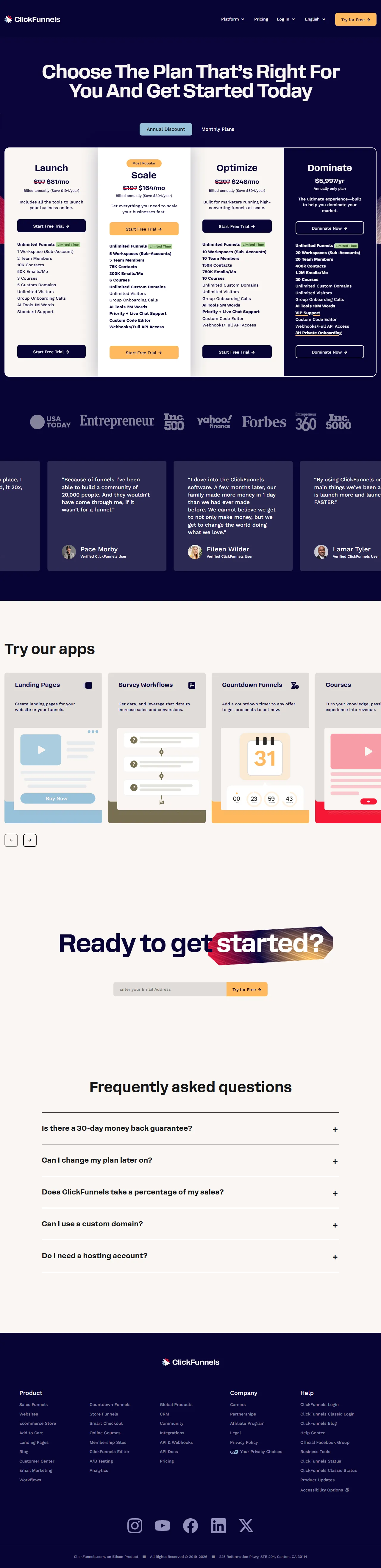
ClickFunnels pricing page, captured September 2026.
Every tier includes a 14-day free trial and a 30-day money-back guarantee, and ClickFunnels charges no platform transaction fee on top — you pay only your payment processor’s standard rate. But there’s no permanent free plan and, unlike Kit or Systeme.io, no tier priced below $97/month. The honest takeaway: annual billing meaningfully lowers the effective cost (roughly two months free on every tier), but budget by the monthly rate if you want the option to walk away without a yearly commitment, and treat the $97/month floor as a real cost of entry, not a rounding error, if you’re pre-revenue.
The funnel builder
This is ClickFunnels’ reason for existing, and it shows. The drag-and-drop editor is purpose-built around the concept of a funnel — a sequence of connected steps — rather than a general website page builder that happens to support forms. You choose a funnel type (lead generation, webinar registration, product launch, tripwire offer), and ClickFunnels scaffolds the whole sequence of pages for you, pre-wired to move a visitor from one step to the next.
The template library reflects over a decade of iteration on what actually converts in direct-response marketing, and the element-level design control is more granular than what you’ll find in flatter all-in-one tools. Unlimited funnels and pages on every tier, including the cheapest one, means you’re never nickel-and-dimed for building more offers — the constraints in ClickFunnels’ pricing show up in contacts, courses, and team seats, not in how many funnels you’re allowed to launch.
Checkout, order bumps, and upsells
ClickFunnels’ native checkout is one of its most mature pieces: order bumps (a low-friction add-on offer at the point of purchase), one-click upsells and downsells (additional offers presented immediately after a purchase, charged to the same card with no re-entry of payment details), and split-testing across any of those steps are all built in rather than stitched together from a payment plugin and a page builder. For a solopreneur running a launch with a real upsell sequence — main offer, order bump, upsell, downsell — this is the part of the product where ClickFunnels’ extra cost is easiest to justify: a well-tuned upsell sequence can lift average order value meaningfully, and the tooling to build and test one is genuinely more capable here than in budget-first all-in-one platforms.
Email and automation
ClickFunnels includes broadcasts, sequences, and a basic CRM with workflow automation triggered by funnel behavior — someone opted in, bought a product, abandoned checkout. Email volume is capped per tier (50,000/month on Launch) independent of your contact limit, which is worth noting if you send frequently to a smaller list.
Where this module falls short is depth: there’s no visual, branching automation canvas comparable to a dedicated email platform, and segmentation tools are basic. ClickFunnels’ own priority, visibly, is the funnel and checkout experience — email exists to support that, not to stand on its own. If list segmentation and behavioral automation are central to how your business operates rather than a supporting piece of a funnel, you’ll likely feel this ceiling sooner than the funnel-builder one. Our best all-in-one marketing platform for solopreneurs roundup compares ClickFunnels against tools that strike a different balance between funnel depth and email depth.
Courses and membership
Course hosting is included with progress tracking, drip content, and gated student access, metered by plan: 3 courses on Launch, 6 on Scale, 10 on Optimize, 20 on Dominate. For a solopreneur selling exactly one course alongside their funnel, that’s rarely a binding constraint — but it’s worth being clear-eyed that you’re paying ClickFunnels’ funnel-tool pricing to get course hosting, not the other way around. The course player is functional, not premium in the way a dedicated course platform markets itself; if the student experience needs to feel like the product itself, that’s a different tool’s job.
Templates and design
ClickFunnels’ template library is large and mature, organized by proven funnel type rather than generic page category, which is a genuinely useful shortcut for someone who knows their offer but not funnel structure. Design control at the element level is more granular than flatter all-in-one competitors, letting you get closer to a fully custom look without touching code — and Scale and above add a custom code editor for anyone who wants to go further still.
The trade-off is that this granularity adds decisions: more options per element means more time spent configuring a page than in a simpler, more constrained editor. For a solopreneur who wants a page live in an afternoon rather than perfected over a week, that flexibility can be a double-edged sword. Our best landing page builders for solopreneurs guide covers lighter-weight, faster alternatives if funnel depth isn’t what you need most.
Ease of use
ClickFunnels asks more of a first-time user than a stripped-down page builder does, precisely because of the flexibility described above — more element options, more funnel-step types, more settings per page. Its onboarding flow and template library soften that curve considerably, and choosing a pre-built funnel type gets most of the structural decisions made for you. Still, expect a real learning period before you’re moving quickly, especially if you’re new to the vocabulary of funnels, order bumps, and split tests rather than general web pages.
ClickFunnels pros and cons
Pros: unlimited funnels and pages on every plan, including the cheapest one; mature, well-tested checkout with order bumps, one-click upsells, and downsells; deep split-testing across funnel steps; a large template and integration ecosystem built over more than a decade; no platform transaction fees on sales.
Cons: no free plan at all, and no tier priced under $97/month; contact and course limits still apply even on paid tiers (10,000 contacts and 3 courses on Launch); email automation and course hosting are noticeably shallower than dedicated specialists; the added design flexibility means a steeper day-one learning curve than simpler tools; jumping from Launch to a tier with meaningfully more contacts or workspaces means a large price step (Scale at $197, Optimize at $297).
Who should skip ClickFunnels
- Pre-revenue solopreneurs who haven’t validated an offer. ClickFunnels has no free plan and no tier below $97/month — the only way to test it beyond the 14-day trial is to pay. Systeme.io’s free plan lets you build and launch the same core funnel structure at $0 first. See our ClickFunnels vs. Systeme.io comparison for the full breakdown.
- Budget-tightest solopreneurs generally, even with some revenue coming in — as of its current pricing, Systeme.io’s top plan lands around the same $97/month as ClickFunnels’ cheapest tier while removing the contact ceiling. Our ClickFunnels vs. Systeme.io comparison and best all-in-one marketing platform for solopreneurs roundup lay out several cheaper paths.
- Newsletter-first or content-first businesses where email sophistication or course polish matters more than funnel conversion — ClickFunnels’ email and course tools are secondary features here, not the focus.
- Anyone who just wants a fast, simple landing page without a multi-step funnel behind it — our best landing page builders for solopreneurs guide covers lighter, often free options built for exactly that.
The verdict
ClickFunnels earns its long-standing reputation as the most mature, deeply featured funnel-building tool a solopreneur can buy, and that maturity is genuinely visible in the checkout, order-bump, upsell, and split-testing tools specifically. If your business already runs on a conversion-focused funnel and every percentage point of optimization translates into real revenue, ClickFunnels’ $97-a-month floor is easy to justify — it’s a rounding error against what a well-tuned funnel produces.
The trade-off is equally real: there’s no free plan, no tier under $97/month, and the email and course modules that ship alongside the funnel builder are clearly secondary to it. For a solopreneur who hasn’t yet proven an offer converts, or whose business needs more balance across email, courses, and funnels than ClickFunnels’ funnel-first design provides, a free or cheaper all-in-one tool is very likely the better starting point — and worth comparing before you commit to ClickFunnels’ price.
FAQ
Does ClickFunnels have a free plan? No. ClickFunnels offers a 14-day free trial plus a 30-day money-back guarantee, but there is no permanent free tier. The cheapest ongoing plan is Launch at $97/month ($81/month billed annually).
How much does ClickFunnels cost in 2026? Four tiers: Launch is $97/month ($81/month annual) for 10,000 contacts and 3 courses. Scale is $197/month ($164/month annual) for 75,000 contacts and 6 courses. Optimize is $297/month ($248/month annual) for 150,000 contacts and 10 courses. Dominate is annual-only at $5,997/year for 400,000 contacts and 20 courses. Funnels and pages are unlimited on every tier.
What’s the difference between Launch, Scale, and Optimize? Mainly ceilings, not features: Launch caps you at 10,000 contacts, 1 workspace, 2 team members, and 3 courses. Scale raises that to 75,000 contacts, 5 workspaces, 5 team members, and 6 courses, and adds a custom code editor plus webhook/API access. Optimize goes to 150,000 contacts, 10 workspaces, 10 team members, and 10 courses. Most solopreneurs running one business start on Launch and only move up when they hit a contact or workspace limit.
Is ClickFunnels better than Systeme.io for a solopreneur? It depends on your stage. ClickFunnels has a more mature funnel editor and deeper split-testing, but starts at $97/month with no free plan. Systeme.io covers the same core funnel structure — plus email and courses — starting at $0. See our ClickFunnels vs. Systeme.io comparison for the full side-by-side.
Does ClickFunnels charge transaction fees on sales? No. ClickFunnels doesn’t take a percentage of what you sell through its checkout on any plan — you pay only your payment processor’s standard rate. The platform fee is the flat monthly subscription alone.
Bottom line
If you’re a solopreneur with a validated, revenue-generating offer and your business depends on squeezing conversion out of a multi-step sales funnel, ClickFunnels is one of the most capable tools you can build on in 2026 — its checkout, upsell, and split-testing tools are among the most capable in the category, and the $97-a-month floor is easy to justify against real funnel revenue. Just go in clear-eyed about what you’re paying for: no free plan, contact and course limits that persist even on paid tiers, and email and course modules that are secondary to the funnel-building core. If you haven’t validated an offer yet, or your budget is the binding constraint, compare ClickFunnels against a free or cheaper all-in-one platform like Systeme.io before you commit — our ClickFunnels vs. Systeme.io comparison and Systeme.io review are the two best next reads to make that call with real numbers instead of marketing copy.